Guide
UST Projector Screen Guide: What Actually Matters
A UST projector throws light upward at a steep angle, so screen choice is not just about size. Surface structure, room lighting, viewing position and frame flatness all change the result.
Affiliate disclosure: We may earn a commission if you buy through merchant links on this page. We do not claim hands-on testing unless explicitly stated.
On this pageWhy UST screens are differentThe four decisions that matter mostWhen Fresnel makes senseWhen lenticular makes senseA sensible buying sequenceFrequently asked questions
Why UST screens are different
A conventional projector sends light from farther back in the room. A UST projector sits close to the wall and sends light up at a steep angle. That geometry is why standard long-throw ALR materials can be a poor match. UST-specific screens are designed to redirect light coming from below while reducing unwanted room light.
The four decisions that matter most
- Room light: side windows and ceiling lights create different problems.
- Surface type: Fresnel and lenticular structures manage light differently.
- Viewing cone: a bright centered image can trade off against off-axis brightness.
- Size and placement: your projector model must support the chosen image size and throw geometry.
When Fresnel makes sense
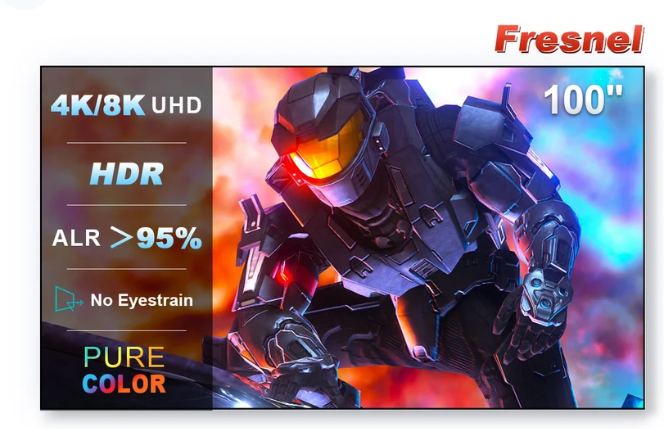
Fresnel UST screens use concentric optical structures that can reject ambient light from more directions than a typical lenticular surface. That can make Fresnel especially interesting in bright rooms with side light. The trade-off is that Fresnel designs commonly have a more limited optimal viewing cone, so seating layout matters.
When lenticular makes sense
Lenticular UST screens use horizontal microstructures that are especially effective against light from above. They commonly offer wider viewing angles and more size or motorized-screen options. In a wide family room with people seated far off-axis, that flexibility can matter more than peak on-axis brightness.
A sensible buying sequence
- Confirm the projector is ultra short throw.
- Choose the target image size.
- Map the room's strongest light sources.
- Measure the seating spread.
- Choose Fresnel, lenticular or a UST-compatible matte surface based on those constraints.
- Only then compare specific products and current prices.
Frequently asked questions
Can I use a normal ALR screen with a UST projector?
Usually not safely. Many long-throw ALR materials are engineered for light arriving from across the room rather than from directly below.
Is a Fresnel screen always better in a bright room?
Not always. It can be very effective when ambient light comes from multiple directions, but a narrower viewing cone may be a poor fit for wide seating.
Do I need an ALR screen in a dark room?
Not necessarily. In a controlled-light room, a flat UST-compatible matte surface can work well; the choice depends on your priorities.
Want the current merchant details?
Check the exact size, variant, shipping availability and current terms before ordering.
View the NothingProjector Fresnel Screen →